Gender norms
A cataclysmic lack of HarmonyGender norms appear as a system of commands that turns an individual into a function for other people. Rather than remaining an abstract social principle, they enter the most ordinary spaces of life—washing, cleaning, earning, raising children, maintaining a home—and make compliance seem like the measure of worth. The resulting pressure is not merely inconvenience: it produces exhaustion, rage, disappointment, and the fear that silence will erase the person subjected to the script.
Definition and Domestic Script
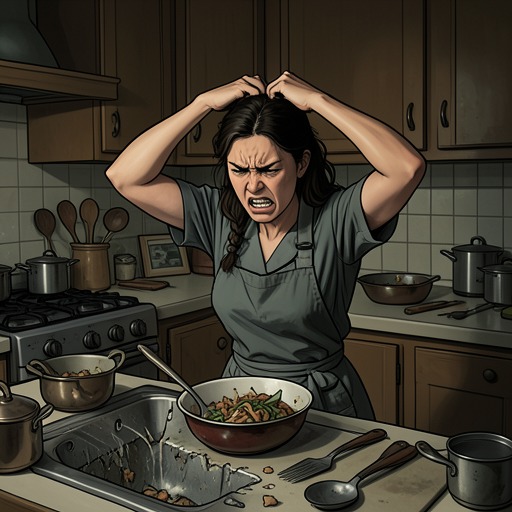
Gender norms are articulated through imperatives that leave little room for refusal. The subject is told to hurry, wash the dishes, and prepare a meal; then to clean the room and vacuum the floor. These tasks are not described as shared responsibilities or negotiated choices. Their clipped, repetitive form makes them sound like an unquestionable routine, as though domestic labor naturally belongs to the person being addressed.
The script expands beyond housework into a complete life plan. The subject is instructed to go to work and buy a nice car, clear the table, have kids, and imagine a future that includes grandchildren. Economic achievement and reproduction are therefore joined to domestic service: the required life is one in which the subject must earn, maintain, reproduce, and continue the family line. Gender norms function here as a timetable as much as a division of labor, prescribing not only what must be done but also what kind of adulthood must eventually be performed.
Labor, Utility, and Objectification
The pressure becomes especially stark when the subject asks what they are to the other person and considers the possibility of being nothing more than a vessel to fill with crude oil. This image converts the human body into a container for an external resource. It suggests that the subject is valued for capacity and usefulness rather than for independent desire, speech, or self-definition. Domestic and economic expectations thus converge in a single logic: the person must be filled, operated, and made productive for someone else’s purposes.
The list of chores gives that objectification a material routine. Cleaning the room, clearing the table, taking out the bin, and making the bed are small acts, but their accumulation makes the burden visible. The norms do not need a spectacular authority to operate. They circulate through repeated instructions until ordinary maintenance becomes a demand for total availability. The command to take out the bin follows the command to make the bed just as the command to have children follows the demand to work, producing a seamless chain between bodily service and social usefulness.
Strain and Embodied Resistance
The subject explicitly describes the difficulty of holding everything together as increasing every day. That statement gives the domestic sequence its consequence: the demands are not successfully absorbed into a stable identity but instead threaten to break the person carrying them. The norms present themselves as practical necessities, yet the text records their psychological and physical cost.
The body registers the conflict through a posture of collapse. With the head between the hands, the subject sits on the floor, no longer appearing as the efficient figure imagined by the commands. Resistance then becomes physically violent: lying against the wall, the subject punches it as hard as possible, continuing until bloody knocks find their way among the hair. The injury does not resolve the imposed expectations, but it exposes the anger that polite compliance conceals. A body demanded to serve becomes the site where refusal, despair, and accumulated pressure can no longer remain invisible.
This violence is directed at the wall rather than clearly at the person issuing the commands. That displacement matters. The structure remains difficult to reach, so frustration is turned against an immediate surface and, through the blood, against the subject’s own body. Gender norms are consequently shown not only as external rules but as pressures that can be internalized until the person suffering under them becomes both witness to and instrument of their own injury.
Disappointment and Intergenerational Judgment
The norms are reinforced by a voice of judgment that declares the subject a disappointment. The accusation, that the subject always disappoints the speaker, transforms failure to satisfy expectations into a permanent moral identity. The problem is no longer that a dish remains unwashed, a room is unclean, or a prescribed milestone has not been reached; the subject is made to feel that disappointment is an enduring characteristic.
The reference to the younger self adds another layer to the rule system. The subject turns toward an earlier version of the self, suggesting that these expectations have a history and that present distress is connected to an older moment of learning how to perform or endure them. The commands about work, marriage-like domesticity, children, and grandchildren are therefore not isolated instructions. They belong to an intergenerational pattern in which one person’s standards are passed down as obligations to another, while the younger self remains exposed to the demand to become acceptable.
Voice, Abandonment, and the Possibility of Refusal
The wider emotional vocabulary surrounding Gender norms is one of abandonment and failed recognition. The subject says that someone left them and describes an eternal, impossible war fought through the flames of disinterest. The conflict is difficult because it is waged against indifference rather than an openly declared opponent: the subject continues to struggle while the other person’s lack of concern supplies the heat.
Speech repeatedly confronts absence. The subject describes talking to the other person as if that person were present, then questions why breath is being wasted, recalling that the two once talked for days and days. This contrast between sustained former conversation and present one-sided speech shows how a relationship can survive as a verbal habit after mutual attention has disappeared. Gendered demands remain audible even when the person who imposed or embodied them is absent, because the subject has already internalized the expectation of explanation and response.
The same pattern appears in the image of silently imitating another person like a shadow. Imitation suggests a performed identity: the subject follows an external shape while remaining secondary to it, visible only as a dependent outline. Day after day and rain after rain lead finally to silence, a recurrence that makes endurance feel cyclical rather than progressive. Words are experienced as weapons, worse than a thousand arrows, while silence is later named a killer and the speaker’s favorite prey. The text therefore frames voice as both danger and necessity: speech can wound, but without speech the subject risks becoming defenseless and unheard.
The plea for someone to hear the subject’s voice intensifies this struggle into an appeal for recognition. In the language of a distress call, inaudible sounds leave the mouth, but reception is uncertain. The subject has reached the point at which ordinary communication no longer guarantees contact; a voice can be produced and still fail to become testimony for anyone else. Gender norms are significant precisely because they help explain the conditions of that failure: a person repeatedly reduced to service is eventually forced to fight for the status of a speaking subject.